
Queen Anne's County's Most Wanted Program
The Queen Anne's County Sheriff's Office runs this program, and it works like a bulletin board rather than a warrant search. Each entry is a request for information about where a person might be. Every one of them repeats the same warning. Do not try to detain or approach anyone. Call the Sheriff's Office instead. That single instruction is the whole point of the layout, written to protect the reader as much as the person named. The Sheriff's Most Wanted page shows the program header, the paging controls and the warning that accompanies every listing.
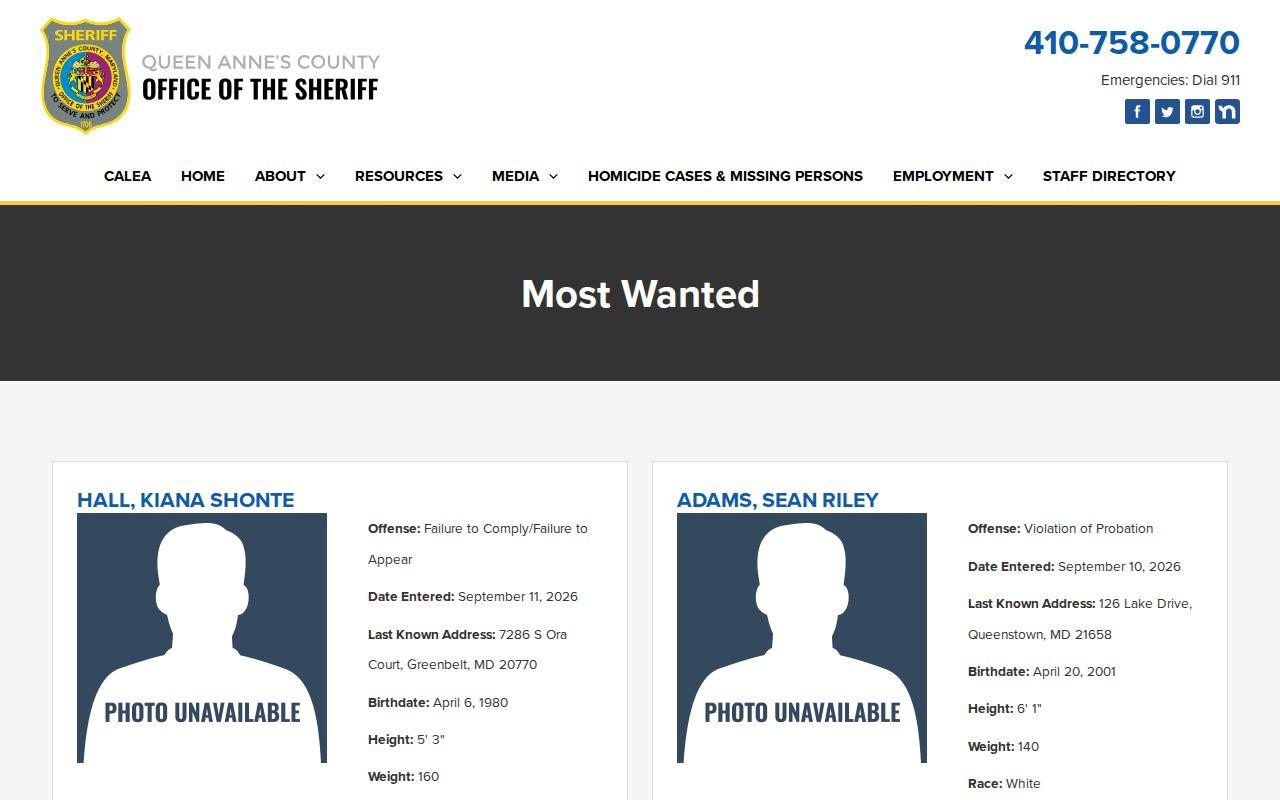
Queen Anne's County publishes navigation and a warning here, not a roster. Read it that way.
How the Most Wanted Lists Work
What Queen Anne's County publishes is a curated subset, not the county's full active-warrant picture. No office here puts that picture out in a searchable form. Entries go up, sit for a while, and come down once the Sheriff's Office decides the listing has done its job. The page states no refresh schedule and no total count. Dated entries show the page is maintained. A date is not a promise that anything was recently confirmed.
Date Entered Is Not a Refresh Date
Every entry carries a date entered. Readers often mistake it for a freshness marker. It is not one. The date records when the listing went up, not when the Sheriff's Office last checked it against the docket. If currency matters, confirm the underlying case with the clerk who holds it. The listing says Queen Anne's County law enforcement is looking for someone; the docket says what the court record actually shows today.
What the Program Entries Show
An entry is descriptive, not legal. It gives the offense, the date entered, a last known address, and physical details such as birthdate, height, weight, race, gender, eye and hair color. A photo area holds either an image or a notice that none is available. What is missing matters just as much. There is no warrant number, no issuing court, no bond figure and no status field, so the page cannot answer a question about your own case. That layout is as far as this page goes. Individual entries stay on the Queen Anne's County Sheriff's site, where they belong.
No Search, Bond, or Warrant Number Controls
The Queen Anne's County page offers pagination and nothing else. No name search. No filter by offense or date, no bond field, no way to separate active from cleared. That is a design choice. The program publicizes a handful of entries, while a searchable list would need the case data the page deliberately leaves out.
Reporting a Tip Safely
Tips reach the Queen Anne's County Sheriff's Office by phone or email. Prefer to stay nameless? The anonymous tip line is 410-758-6666. What the office wants is information about a location.
Key Rule: Contact the Sheriff's Office with what you know and do not approach a listed person. A tip line is for location information, not for a personal records check.
The Official App Carries the Program
The Queen Anne's County Sheriff's Office also publishes a free app for iOS and Android. It carries alerts, weather, an inmate search, the Most Wanted entries and a tip channel. No separate warrant search is advertised. That makes the app handy for sending information and weak for checking a case. It shows the same curated entries as the website. Status questions still belong with the clerk or the warrant division.
Most Wanted Lists vs Active Warrants
One is a public notice, the other a court record. Confusing the two sends Queen Anne's County readers to the wrong office.
| Point | Most Wanted Entry | Active Warrant |
|---|---|---|
| What it is | A published request for information | A court order authorizing an arrest |
| Who controls it | The Sheriff's Office | The issuing court |
| What it contains | Offense, descriptors and a photo area | Case number, charge, court, bond and status |
| How it ends | The entry is removed from the page | Service, recall or quash on the docket |
Tip Line Versus Personal Lookup
A tip and a records question travel in opposite directions. A tip sends information to law enforcement about where someone may be. A personal lookup asks a court or the Sheriff's Office to read a record back to you about your own case. Calling the tip line with a records question wastes everyone's time. It also does nothing to settle your own warrant. For that route, the warrant lookup page covers how to ask a Queen Anne's County court or the Sheriff directly.
Sealed and Juvenile Material Never Appears
Some records can never appear on a public list. Under General Provisions §4-316, an unserved arrest-warrant file stays closed until service and return or 90 days from issue. Juvenile records are confidential under Courts and Judicial Proceedings §3-827. A curated page cannot show what the law keeps sealed. That is one more reason absence from it proves nothing.
No Reward or Refresh Schedule Is Stated
Queen Anne's County publishes its wanted page without a reward, a partner group, or a set review schedule. Some counties run Crime Stoppers programs that pay for tips. This one does not. So nobody here can promise cash for information. A tip still helps the deputies working the case, even without a reward behind it.
If You Think You Are on a List
Don't treat the list as a problem to solve by yourself. An entry is a public notice. It is not a statement of where your case stands now, and the case itself is what counts. Talk to a Maryland attorney first. Then contact the Sheriff's Office or the issuing court about your own matter, and see the steps for handling a Queen Anne's County warrant for more on recall, surrender, and bond.
Important: Never approach a person named on a most-wanted page. If your own name appears, call an attorney and the warrant unit rather than the tip line.